3D Printing & Digital Fabrication
Complex geometry without tooling — printed, joined and finished.
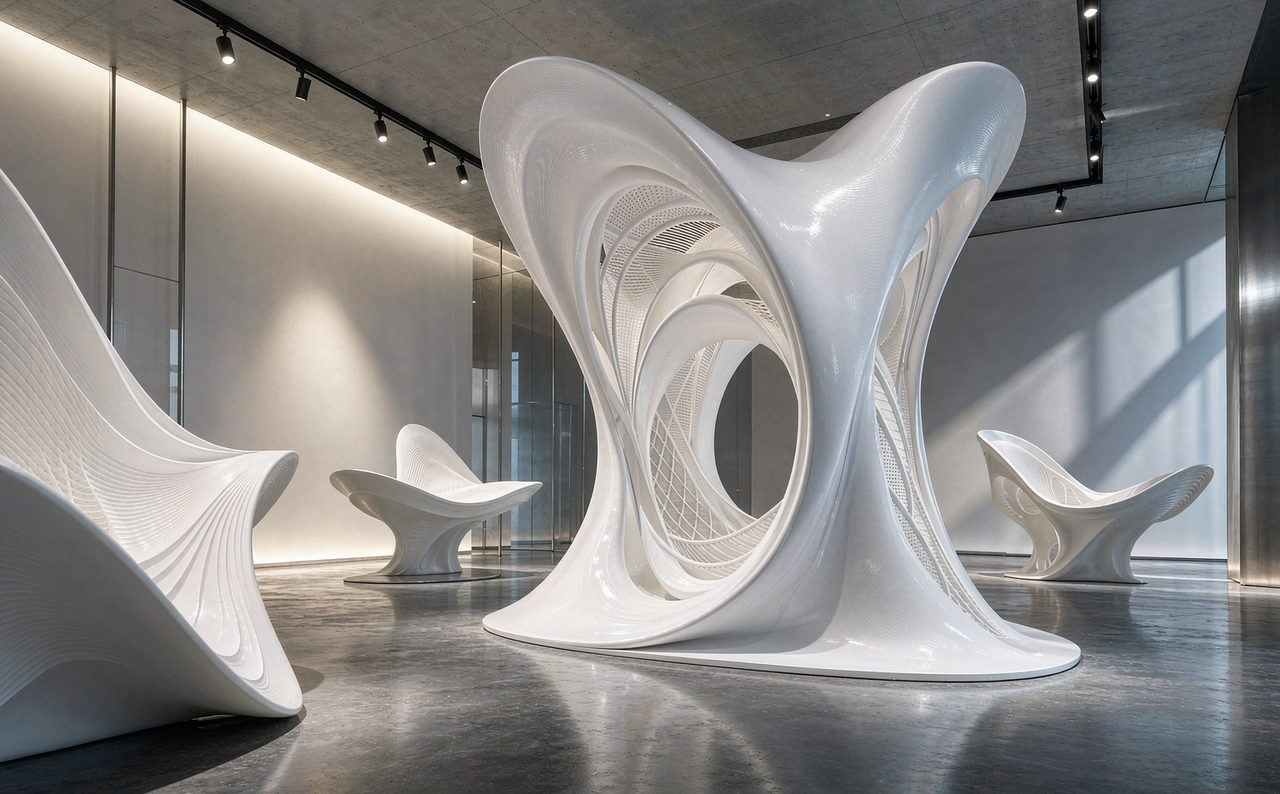
3D printing suits shapes that panels cannot produce, or quantities too small to justify a mould: perforated screens, curved relief, custom brackets and decorative elements. Large pieces are printed in sections and joined on a hidden internal frame.
Its real advantage is iteration. A scale model can be printed in days, checked in the hand and adjusted before any mould is cut — which is why we often print master patterns that are then used to cast gypsum or cement production pieces.
What we deliver
- Digital modelling from sketches, scans or reference images
- Large-format printing, section splitting and structural joining
- Sanding, priming, painting and surface texturing
- Master-pattern printing for subsequent casting
Techniques in this group
Questions on this capability
What is the maximum size of a single printed part?
Single parts are limited by printer capacity and are therefore printed in sections and joined. The overall size of the finished piece is effectively unrestricted; the joints are planned to fall on geometric edges.
Is printed material durable enough for outdoors?
It depends on the resin and coating. For outdoor use we specify UV-stable material plus a protective topcoat, and treat the printed surface as a substrate to be finished rather than a final surface.
Planning a 3d printing & digital fabrication project?
Tell us the substrate, viewing distance and destination. We will recommend a technique and a reference band.
Request a quoteHow export works