Digital sculpture modelling
Digital modelling - the file everything else is produced from.
Overview
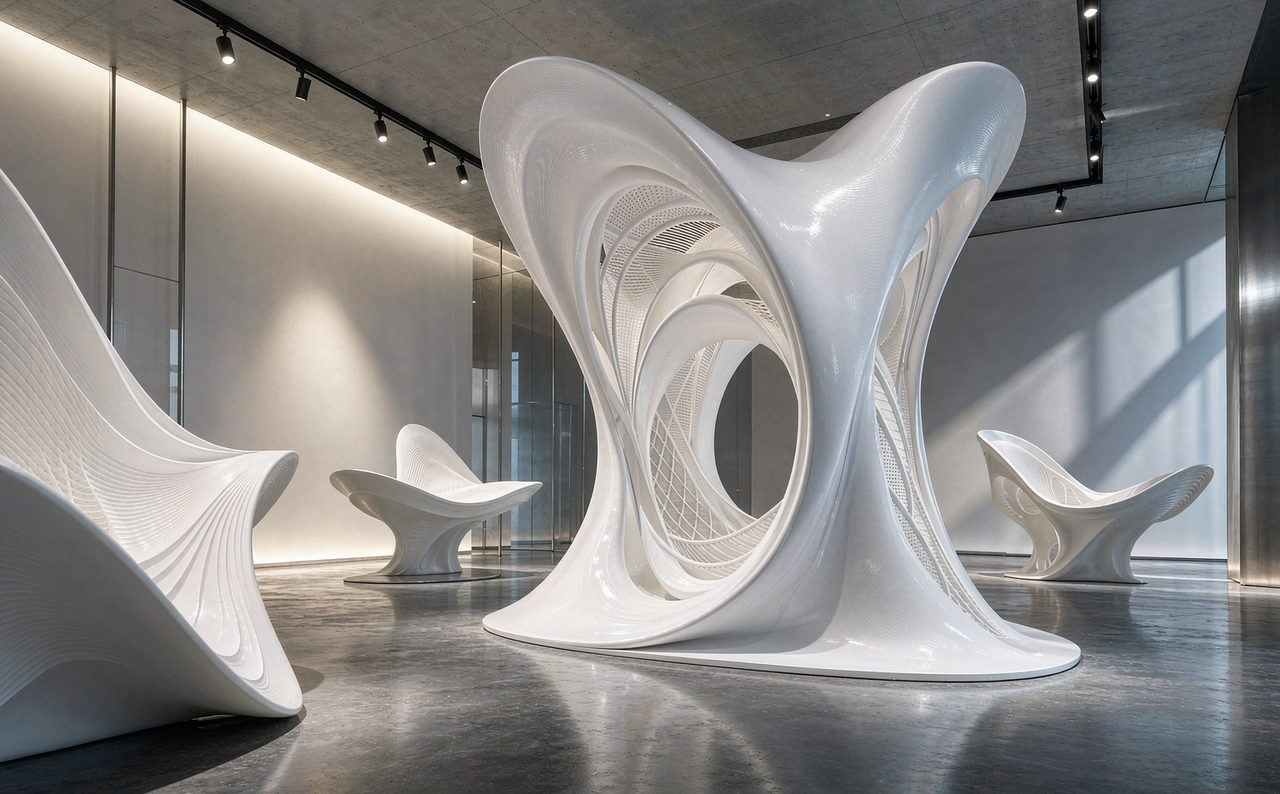
Modelling turns a sketch, a photograph or a scan into a file that can be printed, CNC-cut, cast or rendered. It is the least visible part of a project and the one that decides whether everything downstream fits.
When to choose it
Digital modelling and scanning is the front end of almost every complex commission: it turns an idea, an existing object or a site into data that can be made. It is chosen when a form must be checked before it is built, when an existing object must be reproduced, or when the geometry is too complex to communicate in drawings. It is not a substitute for design judgment; a model is only as good as the decisions behind it.
How it is made
Existing objects and sites are scanned by photogrammetry or structured light, then cleaned up, because raw scans are always noisy and need interpretation rather than direct use. New forms are modelled from the brief and reviewed against the site at scale before anything is fabricated. Files are prepared for the actual production process - printing, CNC, casting - with the tolerances, wall thicknesses and section splits that process requires. Deliverables usually include the model, the drawings and the production files.
Typical specifications
| Deliverables | STL, STEP, OBJ, DWG and render outputs |
|---|---|
| Sources | Sketch, reference photography, photogrammetry, laser scan |
| Capability | Organic sculpting, hard-surface modelling, repair of damaged scans |
| Lead time | 2 days to 3 weeks |
Typical applications
- Sculpture and relief modelling
- Scanned object restoration
- Fabrication and setting-out files
- Renders and approvals
- File preparation for CNC and moulds
What goes wrong on site
- Using a raw scan directly, which carries noise, holes and incorrect scale into the production files.
- Modelling for the screen without checking against the site, so proportions that look right on a monitor are wrong in place.
- Delivering a model without production files; a model no process can make is not a deliverable.
Before an overseas project starts
Source material
Tell us what exists - sketches, photographs, an object to scan, a site. The starting point decides the method and the timetable.
Production process
Tell us how the piece will be made. Files must be prepared for printing, CNC or casting, and the requirements differ.
Scale and accuracy
Send the key dimensions and the tolerance that matters. It governs the scanning method and the survey required.
Questions buyers ask
Can you work from photographs only?
Yes for many subjects, but accuracy improves sharply with a 3D scan or measured drawings. We will tell you when photographs are not enough.
Do we receive the source files?
Yes, on handover, in agreed formats including the editable source file. Retaining the model matters when a piece needs reproducing later.
How a project runs
- 1. EnquirySend photographs, drawings or a 3D file with approximate dimensions and your target date. A short written brief is enough to start.
- 2. Technique recommendationWe come back with the technique that fits your substrate, viewing distance and budget, plus the alternatives we rejected and why.
- 3. Sample and quotationA colour or material sample where relevant, and a costed quotation split into material, labour, finishing, packing and freight.
- 4. ProductionWork proceeds in our own workshop with dated progress photographs at agreed milestones.
- 5. Packing and shippingCrated and marked to your forwarder's requirements, with the full export document set prepared in advance.
- 6. Installation or handoverOur own crew installs on site, or we supply a fixing method statement and supervise your contractor locally.
Packing, shipping and export
Overseas projects are normal work for us, and packing is designed for the journey rather than added afterwards. Components are numbered against a packing list so assembly on site follows the drawings.
- Export plywood crates with foam blocking, desiccant and heat-treated (ISPM 15) timber
- Each crate marked with the shipping mark, crate number, gross and net weight and handling symbols
- Packing list keyed to the assembly drawings, so parts are identifiable on arrival
- Full document set: commercial invoice, packing list, certificate of origin and fumigation certificate
- Delivery on EXW, FOB, CIF or DDP terms depending on your forwarder arrangements
- Container loading plan supplied for large or irregular items, with a photo record of loading
Commercial terms
| Payment | Deposit on order, balance before shipment; T/T or as agreed in the contract |
|---|---|
| Currency | RMB or USD, invoiced in the agreed currency |
| Validity | Quotations held for 30 days unless stated otherwise |
| Scope basis | Material, labour, finishing, packing and freight quoted as separate lines |
| Changes | Variations priced in writing before the work proceeds |
| Warranty | Defects against workmanship and material failure within the agreed warranty period |
Quality control
- Dimensional and finish checks at each production milestone, not only at the end
- Dated progress photographs sent to the client throughout production
- Pre-shipment assembly trial for multi-part pieces, so site fit is verified before dispatch
- Third-party inspection welcome; we will prepare the access and documentation needed
- Written handover with material and colour records, so later repairs can be matched
Other techniques in this capability
Film props & display stands
Film props and display stands - shape-accurate and quick to turn round.
Read guide →Large-scale 3D-printed sculpture
Large-scale 3D printing - organic form without the mould cost.
Read guide →Post-processing & finishing
Post-processing - what turns a printed surface into a finished object.
Read guide →All 3D Printing & Digital Fabrication techniques · Full capability page · Complete technique library
Need this technique on your project?
Send the brief, approximate dimensions and destination. We will come back with a technique recommendation and a reference price band.
Request a quoteHow export works