Prototype & sample printing
Prototypes and samples - approve the object before committing to production.
Overview
A physical sample resolves arguments that drawings cannot: scale, feel, colour and how a detail reads under real light. We print or model a sample first, so production tooling is only committed once the object is agreed.
When to choose it
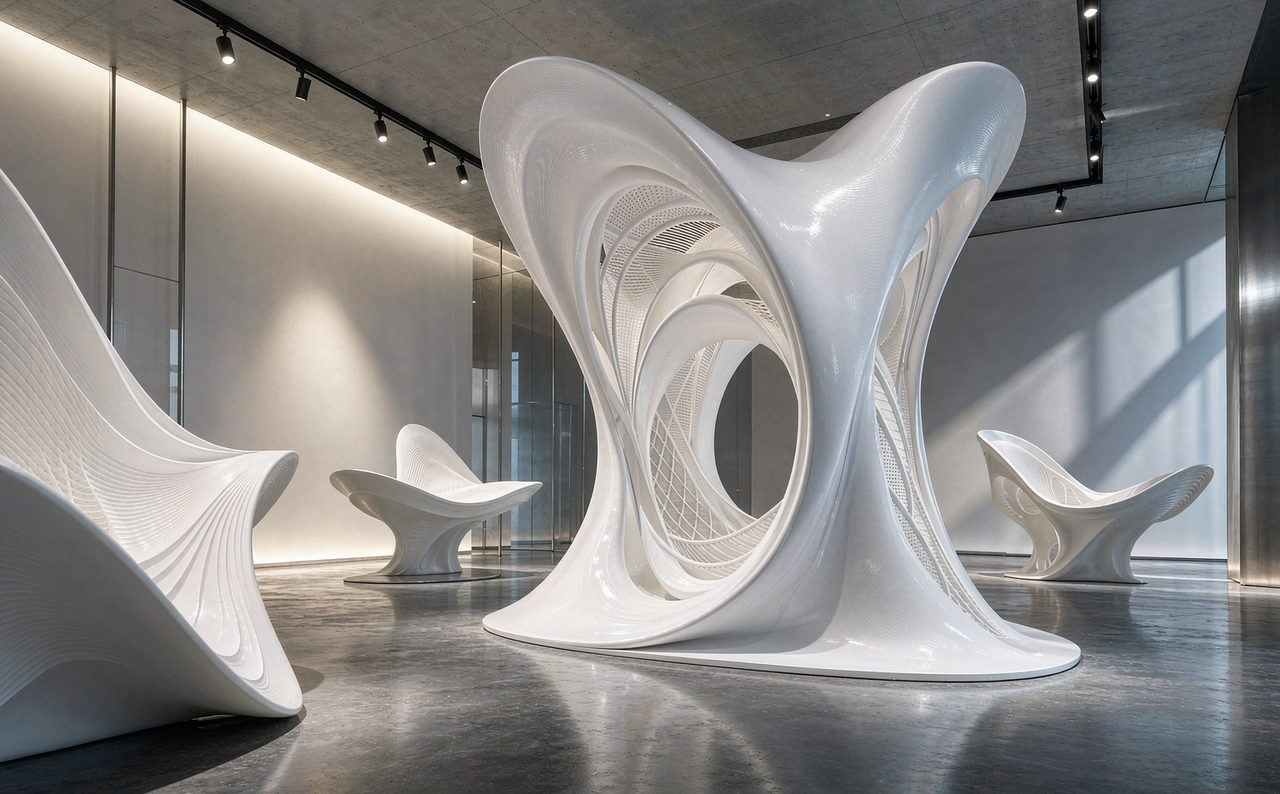
Hand-finished printed models are chosen where a form should read as hand-made while benefiting from digital accuracy - sculptural pieces, maquettes, art editions, character work. The printing provides the geometry; the finishing provides the surface, and the finished quality depends overwhelmingly on the second stage. It is the wrong approach where the budget covers printing only, because an unfilled print reads as a manufactured object rather than as a sculpture.
How it is made
The model is printed in sections and assembled, then the surface is worked by hand: filling the layer lines, sanding through successive grades, and carving or texturing where the design calls for it. Textures and imperfections are added deliberately, since a perfectly uniform surface reads as plastic. The piece is then primed and finished in the intended material appearance - stone, bronze, clay - with the finish matched to a physical sample. Handling and transport are planned for a piece that is far more delicate than its printed core suggests.
Typical specifications
| Typical size | Hand-held maquettes to 1:1 detail samples |
|---|---|
| Materials | Resin for fine detail, FDM for larger forms |
| Finishing | Primed and painted to the intended production finish |
| Lead time | 2-7 days |
Typical applications
- Design verification samples
- Scale maquettes
- Colour and finish mock-ups
- Client presentation models
- Pre-production tooling checks
What goes wrong on site
- Budgeting for printing and not for finishing, when the finishing is where the quality actually comes from.
- Sanding only to a uniform smoothness, which produces a surface that reads as manufactured rather than as worked.
- Skipping the sample approval, given how differently a finished surface reads against its reference material.
Before an overseas project starts
Level of finish
Tell us how close the piece will be viewed. Finishing effort scales directly with viewing distance and should be budgeted to it.
Intended material
Stone, bronze, clay and ceramic each need different filling, priming and finishing. Send a reference and we will sample it.
Handling
Finished pieces are more fragile than they look. Tell us how it will be moved and displayed so we can plan protection.
Questions buyers ask
What scale should a maquette be?
Usually 1:10 or 1:20 for large pieces and 1:1 for detail and finish approval. Scale is chosen for the decision the sample has to support.
Can the sample match the final finish exactly?
Closely, if we are told the intended production material and coating. It will not be identical, but it is close enough to approve colour and form.
How a project runs
- 1. EnquirySend photographs, drawings or a 3D file with approximate dimensions and your target date. A short written brief is enough to start.
- 2. Technique recommendationWe come back with the technique that fits your substrate, viewing distance and budget, plus the alternatives we rejected and why.
- 3. Sample and quotationA colour or material sample where relevant, and a costed quotation split into material, labour, finishing, packing and freight.
- 4. ProductionWork proceeds in our own workshop with dated progress photographs at agreed milestones.
- 5. Packing and shippingCrated and marked to your forwarder's requirements, with the full export document set prepared in advance.
- 6. Installation or handoverOur own crew installs on site, or we supply a fixing method statement and supervise your contractor locally.
Packing, shipping and export
Overseas projects are normal work for us, and packing is designed for the journey rather than added afterwards. Components are numbered against a packing list so assembly on site follows the drawings.
- Export plywood crates with foam blocking, desiccant and heat-treated (ISPM 15) timber
- Each crate marked with the shipping mark, crate number, gross and net weight and handling symbols
- Packing list keyed to the assembly drawings, so parts are identifiable on arrival
- Full document set: commercial invoice, packing list, certificate of origin and fumigation certificate
- Delivery on EXW, FOB, CIF or DDP terms depending on your forwarder arrangements
- Container loading plan supplied for large or irregular items, with a photo record of loading
Commercial terms
| Payment | Deposit on order, balance before shipment; T/T or as agreed in the contract |
|---|---|
| Currency | RMB or USD, invoiced in the agreed currency |
| Validity | Quotations held for 30 days unless stated otherwise |
| Scope basis | Material, labour, finishing, packing and freight quoted as separate lines |
| Changes | Variations priced in writing before the work proceeds |
| Warranty | Defects against workmanship and material failure within the agreed warranty period |
Quality control
- Dimensional and finish checks at each production milestone, not only at the end
- Dated progress photographs sent to the client throughout production
- Pre-shipment assembly trial for multi-part pieces, so site fit is verified before dispatch
- Third-party inspection welcome; we will prepare the access and documentation needed
- Written handover with material and colour records, so later repairs can be matched
Other techniques in this capability
Film props & display stands
Film props and display stands - shape-accurate and quick to turn round.
Read guide →Large-scale 3D-printed sculpture
Large-scale 3D printing - organic form without the mould cost.
Read guide →Post-processing & finishing
Post-processing - what turns a printed surface into a finished object.
Read guide →All 3D Printing & Digital Fabrication techniques · Full capability page · Complete technique library
Need this technique on your project?
Send the brief, approximate dimensions and destination. We will come back with a technique recommendation and a reference price band.
Request a quoteHow export works