Custom-shaped printed components
Custom-shaped components where conventional fabrication will not do.
Overview
Printing is at its most useful when a part is complicated but the quantity is low: brackets, ducts, connectors and sculpted details that would otherwise need moulds or expensive machining.
When to choose it
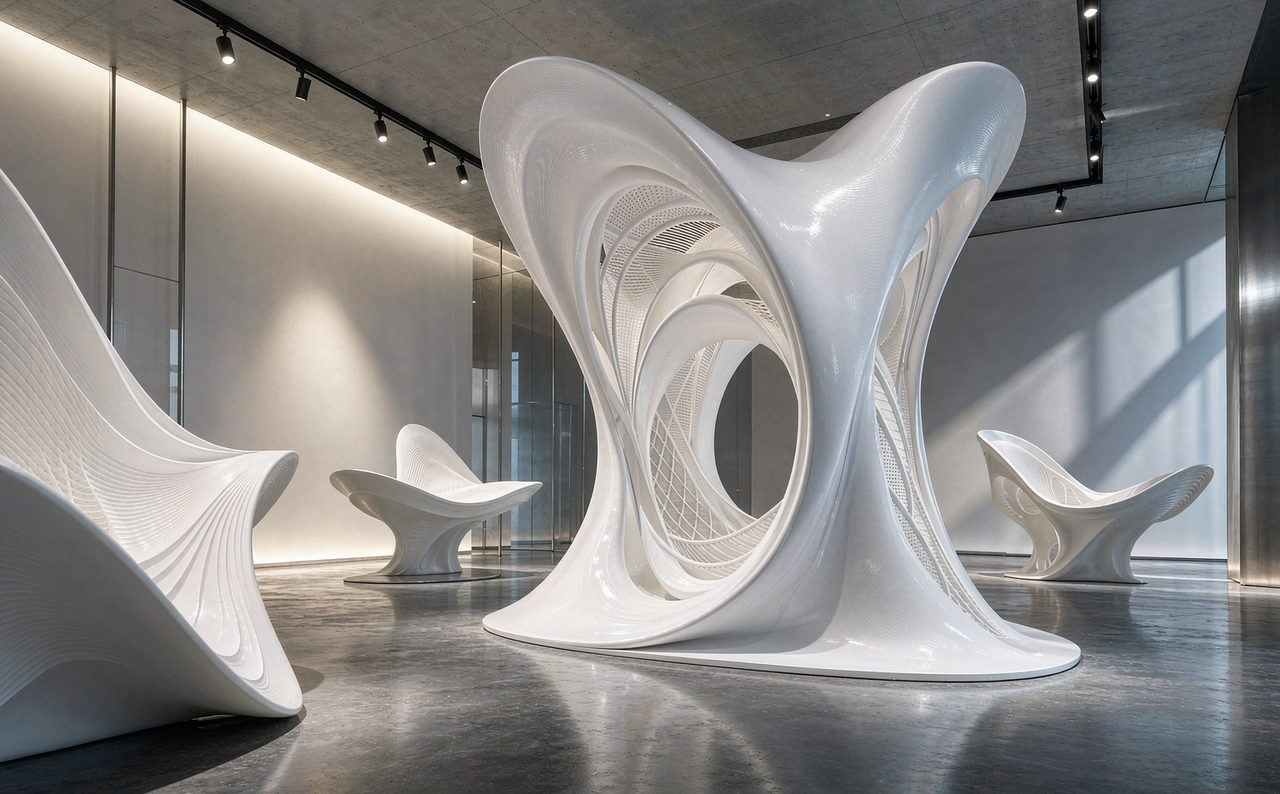
Printed custom components are chosen where a part is geometrically impossible or uneconomic to make by conventional means - complex internal channels, organic brackets, one-off fittings, adaptors. They suit architectural details, bespoke fixings, exhibition hardware and prototype parts. The judgment is straightforward: printing wins when the shape is genuinely complex and the quantity is small. Above roughly a few hundred identical parts, or where a simple shape can be cut, pressed or moulded, conventional methods take over on unit cost, so the honest dividing line is complexity against volume rather than print quality.
How it is made
The component is designed for the printing process from the start, with wall thicknesses, overhangs and load direction considered so the part is strong where it needs to be. Material is chosen against the real service conditions - temperature, UV, chemical contact and load - rather than by what is quickest to print. Tolerances are set for the intended fit, and critical dimensions are verified after printing rather than assumed. Where the part is functional, a prototype is tested before the batch is produced. Orientation on the build plate is decided by the load path, because a part printed across its weakest direction fails at a fraction of the load it would otherwise carry, and internal channels are designed with the escape of support material in mind so they can actually be cleared after printing.
Typical specifications
| Tolerance | Typically +/- 0.2 mm on smaller parts, wider on large formats |
|---|---|
| Materials | PLA, PETG, ABS, ASA, nylon, resin, composite |
| Processes | FDM for large parts, SLA/DLP for fine detail |
| Lead time | 3 days to 3 weeks |
Typical applications
- Architectural connectors and nodes
- Sculpted facade details
- Machine and equipment parts
- Set and prop mechanisms
- Replacement or obsolete components
What goes wrong on site
- Designing a part as if it were machined and then printing it, which produces stress concentrations exactly where the load is.
- Ignoring the printing orientation, since the layer direction determines where the part will fail.
- Skipping prototype testing on functional parts, where the failure only appears under load.
Before an overseas project starts
Function and load
Tell us what the part does and what it carries. Material and geometry both follow from that, not from appearance.
Service conditions
Temperature, UV, moisture and chemicals. These rule out some materials immediately and are worth knowing early.
Tolerance and fit
Tell us what it fits into. Printed parts need their tolerances set deliberately for the mating component.
Questions buyers ask
Can you print a one-off replacement part?
Yes. Send a photograph, a drawing or a 3D scan and we will model and print it, which is often far quicker than sourcing an original.
Is printing cheaper than machining?
For one or two complex parts, usually yes. For simple parts or higher quantities, machining or moulding normally wins - and we will say so.
How a project runs
- 1. EnquirySend photographs, drawings or a 3D file with approximate dimensions and your target date. A short written brief is enough to start.
- 2. Technique recommendationWe come back with the technique that fits your substrate, viewing distance and budget, plus the alternatives we rejected and why.
- 3. Sample and quotationA colour or material sample where relevant, and a costed quotation split into material, labour, finishing, packing and freight.
- 4. ProductionWork proceeds in our own workshop with dated progress photographs at agreed milestones.
- 5. Packing and shippingCrated and marked to your forwarder's requirements, with the full export document set prepared in advance.
- 6. Installation or handoverOur own crew installs on site, or we supply a fixing method statement and supervise your contractor locally.
Packing, shipping and export
Overseas projects are normal work for us, and packing is designed for the journey rather than added afterwards. Components are numbered against a packing list so assembly on site follows the drawings.
- Export plywood crates with foam blocking, desiccant and heat-treated (ISPM 15) timber
- Each crate marked with the shipping mark, crate number, gross and net weight and handling symbols
- Packing list keyed to the assembly drawings, so parts are identifiable on arrival
- Full document set: commercial invoice, packing list, certificate of origin and fumigation certificate
- Delivery on EXW, FOB, CIF or DDP terms depending on your forwarder arrangements
- Container loading plan supplied for large or irregular items, with a photo record of loading
Commercial terms
| Payment | Deposit on order, balance before shipment; T/T or as agreed in the contract |
|---|---|
| Currency | RMB or USD, invoiced in the agreed currency |
| Validity | Quotations held for 30 days unless stated otherwise |
| Scope basis | Material, labour, finishing, packing and freight quoted as separate lines |
| Changes | Variations priced in writing before the work proceeds |
| Warranty | Defects against workmanship and material failure within the agreed warranty period |
Quality control
- Dimensional and finish checks at each production milestone, not only at the end
- Dated progress photographs sent to the client throughout production
- Pre-shipment assembly trial for multi-part pieces, so site fit is verified before dispatch
- Third-party inspection welcome; we will prepare the access and documentation needed
- Written handover with material and colour records, so later repairs can be matched
Other techniques in this capability
Film props & display stands
Film props and display stands - shape-accurate and quick to turn round.
Read guide →Large-scale 3D-printed sculpture
Large-scale 3D printing - organic form without the mould cost.
Read guide →Post-processing & finishing
Post-processing - what turns a printed surface into a finished object.
Read guide →All 3D Printing & Digital Fabrication techniques · Full capability page · Complete technique library
Need this technique on your project?
Send the brief, approximate dimensions and destination. We will come back with a technique recommendation and a reference price band.
Request a quoteHow export works