Chinese New Year VM
Chinese New Year installations - the year's biggest retail moment.
Overview
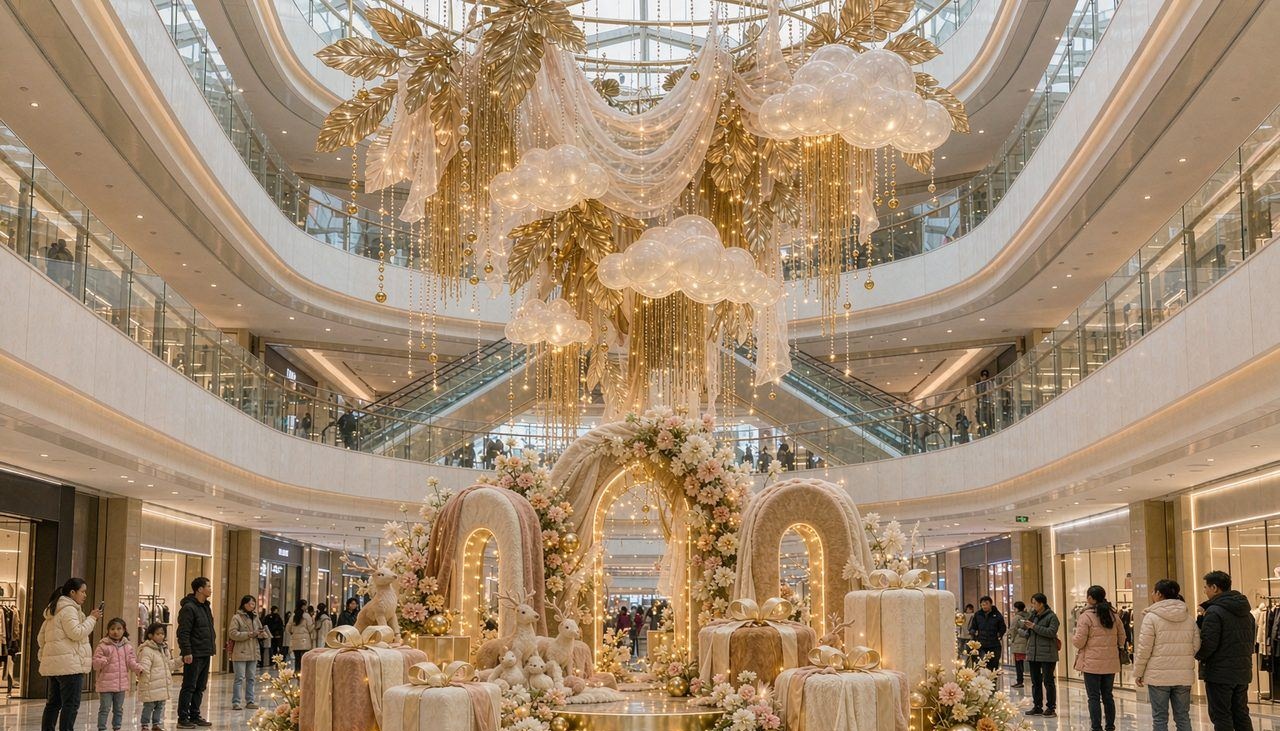
New Year installations are judged on impact from a distance, photographability and how quickly they can be installed and removed. They usually combine structure, lighting, fabric and graphics, and they are built to a fixed, immovable deadline.
When to choose it
Spring Festival installations are chosen where a space needs to feel festive for a defined, short period and to photograph well for the people passing through it. They suit malls, hotel lobbies, transport hubs and corporate entrances. The economics are unusual: the piece must be built fast, look generous, and then come down without damage, so design decisions are driven by material reuse and dismantling as much as by appearance.
How it is made
Design starts from the installation window and the removal date, because both constrain the build method and the material choices more than the aesthetic does. Structure is modular, so it can be delivered in sections, assembled out of hours and struck in the same sequence. Elements are designed for reuse across seasons, with the branded and dated parts kept replaceable and the structure kept generic. Lighting is integrated into the modular units, since separate lighting is what makes these installations slow to rig and slow to remove.
Typical specifications
| Typical size | 3 m entrance feature to 200 m2 atrium scheme |
|---|---|
| Lead time | 4-8 weeks; production must be complete before the holiday shutdown |
| Structure | Modular steel or aluminium frame, bolted and demountable |
| Compliance | Fire-rated materials and electrical certification supplied |
Typical applications
- Mall atria and entrances
- Department stores
- Hotel lobbies
- Corporate entrances
- Street and plaza decoration
What goes wrong on site
- Designing a bespoke structure that cannot come apart, so the removal costs nearly as much as the build.
- Specifying a finish that will not survive the installation period given the traffic, which is where the piece actually lives.
- Leaving lighting as a separate scope, which adds days to both the rig and the strike.
Before an overseas project starts
Install and removal windows
Tell us both dates and the hours available on site. They decide the build method more than the design does.
Site constraints
Ceiling height, load capacity, power supply and access route. Festive pieces are usually large and these four limits shape everything.
Reuse intent
Tell us if any part must be reusable next year. It is much cheaper to design for reuse than to adapt afterwards.
Questions buyers ask
Can the installation be reused next year?
Partially. Structure and lighting are usually reusable; graphics and fabric elements are refreshed. We mark reusable components on the packing list at de-rig.
How is fire safety handled indoors?
With certified fire-retardant fabric and documented electrical components. Malls require the certificates before installation, so they are prepared in advance.
How a project runs
- 1. EnquirySend photographs, drawings or a 3D file with approximate dimensions and your target date. A short written brief is enough to start.
- 2. Technique recommendationWe come back with the technique that fits your substrate, viewing distance and budget, plus the alternatives we rejected and why.
- 3. Sample and quotationA colour or material sample where relevant, and a costed quotation split into material, labour, finishing, packing and freight.
- 4. ProductionWork proceeds in our own workshop with dated progress photographs at agreed milestones.
- 5. Packing and shippingCrated and marked to your forwarder's requirements, with the full export document set prepared in advance.
- 6. Installation or handoverOur own crew installs on site, or we supply a fixing method statement and supervise your contractor locally.
Packing, shipping and export
Overseas projects are normal work for us, and packing is designed for the journey rather than added afterwards. Components are numbered against a packing list so assembly on site follows the drawings.
- Export plywood crates with foam blocking, desiccant and heat-treated (ISPM 15) timber
- Each crate marked with the shipping mark, crate number, gross and net weight and handling symbols
- Packing list keyed to the assembly drawings, so parts are identifiable on arrival
- Full document set: commercial invoice, packing list, certificate of origin and fumigation certificate
- Delivery on EXW, FOB, CIF or DDP terms depending on your forwarder arrangements
- Container loading plan supplied for large or irregular items, with a photo record of loading
Commercial terms
| Payment | Deposit on order, balance before shipment; T/T or as agreed in the contract |
|---|---|
| Currency | RMB or USD, invoiced in the agreed currency |
| Validity | Quotations held for 30 days unless stated otherwise |
| Scope basis | Material, labour, finishing, packing and freight quoted as separate lines |
| Changes | Variations priced in writing before the work proceeds |
| Warranty | Defects against workmanship and material failure within the agreed warranty period |
Quality control
- Dimensional and finish checks at each production milestone, not only at the end
- Dated progress photographs sent to the client throughout production
- Pre-shipment assembly trial for multi-part pieces, so site fit is verified before dispatch
- Third-party inspection welcome; we will prepare the access and documentation needed
- Written handover with material and colour records, so later repairs can be matched
Other techniques in this capability
Groundscape & scene installation
Groundscape and full-scene installations that visitors walk through.
Read guide →Light-art installation
Light-art installations built around the light source, not the object.
Read guide →Interactive sensor installation
Interactive installations driven by sensors, gesture or sound.
Read guide →IP collaboration VM
Licensed IP installations, produced to the rights holder's standards.
Read guide →All Visual Merchandising & Installations techniques · Full capability page · Complete technique library
Need this technique on your project?
Send the brief, approximate dimensions and destination. We will come back with a technique recommendation and a reference price band.
Request a quoteHow export works